The journey with Parkinson’s disease is not like a straight line. Slowly, silently, and ignorantly, the symptoms take away the pleasure from the life of the patients. Eventually, the patient starts depending upon other people for the completion of routine tasks, and their self-confidence also fades away.
This disease is also affecting the families of the patient because they can’t see their loved one suffering. By recognizing the specific challenges of stages of Parkinson’s disease, patients and their families are empowered to take proactive measures, ensuring that medical interventions are timed perfectly to maintain independence.
At Parkinson’s MD Care, we bridge the gap between diagnosis and long-term wellness under the expert leadership of Dr. Jawad A. Bajwa, a USA-certified Interventional Neurologist with over 25 years of experience. He brings a global standard of neurological excellence to Pakistan.
Our clinic specializes in a modern, patient-centered approach, offering access to advanced therapies such as DBS Surgery and personalized management plans. This article focuses on the progression of Parkinson’s disease by dividing it into 5 steps. Moreover, it also provides important information about the role of DBS surgery in the treatment of Parkinson’s disease.
Parkinson’s disease is a progressive neurological condition that affects movement. Understanding Parkinson’s Disease Causes is important, as it occurs when nerve cells in the brain fail to produce enough dopamine, a chemical responsible for smooth, coordinated muscle movements. The scale used by neurologists to categorize Parkinson’s disease is called the Hoehn and Yahr scale.
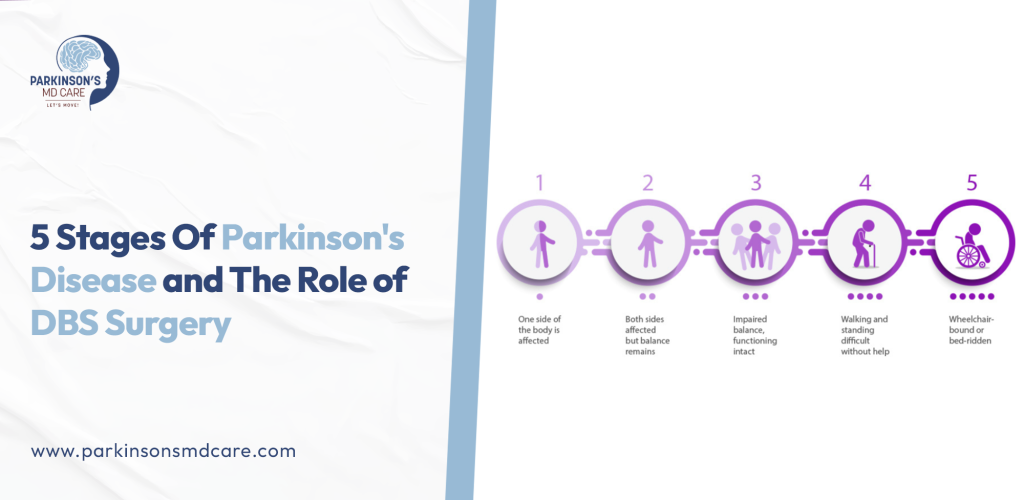
In order to simplify, Parkinson’s disease is divided into 5 main stages. The first stage is the mildest, while the last stage is the most advanced stage of this condition. These stages are important both for the patient and the doctor. They help to plan the most effective parkinson’s disease treatment.
It is the earliest phase of Parkinson’s disease. Symptoms of the patient are very mild and are often easily ignored. They are easily dismissed as signs of aging or stress. A slight tremor might appear in just one hand. A person’s arm might not swing when they walk. There may be a subtle change in the posture. In most of the cases, patients continue their life normally.
With time, the symptoms start to appear more frequently. It is the stage when patients start realizing that there is something wrong with their body. If the symptoms were initially on one side of the body, they start migrating towards the other side. During this stage, normal walking becomes slightly more difficult. The family members notice the poor posture of the patient. Although the patient can live independently, there is a problem while performing daily tasks. Sometimes the muscles become stiff, due to which movement can become slower. Finally, the patient usually starts worrying about the symptoms.
This is considered “mid-stage.” The defining feature here is a loss of balance and reflexes. Slowing of movements (bradykinesia) is now common. Falls become frequent and are a significant risk. Patients feel difficulty in walking or turning. They also feel anxious and avoid people because of losing their coordination. Emotional stress increases in this stage. They may start medications to control their symptoms.
Symptoms are now severe and limiting in this stage. Living alone is not safe for the patient. Patients need assistance in daily activities. The stiffness and slowness keep increasing. Any fluctuations in medication or missing doses may cause the symptoms to appear stronger. At this stage, both the patient and their family find it challenging to manage Parkinson’s disease.
In the final stage, stiffness in the legs may make it impossible to stand or walk. The patient is fully dependent on others and is usually confined to a wheelchair or bed. Full-time care is provided to a Parkinson’s disease patient. This stage is the most challenging for patients, and they want treatment beyond medications to help themselves. The focus shifts heavily toward comfort, dignity, and specialized palliative care.
| Stage | Physical Impact | Level of Independence | Typical Symptoms | Impact on Life |
|---|---|---|---|---|
| Stage 1 | Unilateral (One side) | Fully Independent | Mild tremors, slight change in facial expression. | Minimal impact |
| Stage 2 | Bilateral (Both sides) | Independent | Stiffness, tremors on both sides, and posture changes. | Daily tasks slow down |
| Stage 3 | Mid-stage / Balance loss | Physically Independent | Frequent falls, slow movements, difficulty with tasks. | Reduced independence |
| Stage 4 | Severe disability | Requires Assistance | Significant mobility issues; unable to live alone. | Emotionally stressed |
| Stage 5 | Advanced / Bedridden | Requires 24/7 Care | Inability to walk; potential hallucinations or dementia. | Requires full-time care |
There are different types of treatments available for Parkinson’s disease. Although it cannot be completely cured, the symptoms can be controlled effectively. Many Myths About Parkinson’s Disease can lead to misunderstandings, but treatment depends on the stage and severity of symptoms. Both surgical and non-surgical options are available and are mentioned below:
Medication: In the early stages of Parkinson’s disease, the treatment is medication-based, and lifestyle changes are recommended. However, levodopa has been regarded as the gold standard, being employed for several decades to control symptoms of the disease.
It works by increasing the level of dopamine in the brain in order to control motor functions. However, after taking the drug for a certain period, its effectiveness becomes lower, and large doses are required. Also, side effects of the drugs, such as involuntary movements, occur.
Physical and Occupational Therapy: As soon as the patient receives a diagnosis, they start the therapy advised by the neurosurgeon. The treatment involves strengthening the muscles of the patient and teaching him how to cope with this condition.
Physical therapy is extremely important to increase the mobility of patients suffering from Parkinson’s disease.
Speech Therapy: This therapy is very important to help with a soft voice. It also helps the patient to overcome swallowing difficulties. Communication is improved due to speech therapy for Parkinson’s patients.
Lifestyle Alterations: Dietary and physical activity alterations play a crucial role in managing the symptoms associated with Parkinson’s disease. Healthy eating habits and physical activities maintain the health of the muscles, which are moved by the command of the brain.
Deep Brain Stimulation Therapy: This therapy is considered the strongest cure for Parkinson’s disease. This treatment requires surgery in which a device is implanted into the brain of the patient.This device provides electrical signals to the Brain necessary to control the patient’s movement. It is one of the most successful treatment options for Parkinson’s disease.
Deep Brain Stimulation (DBS) is often described by patients as “turning back the clock.” This Guide to DBS Surgery helps explain that it is not a cure, but for the right candidate, it can dramatically reduce the symptoms that medication can no longer control.
It is typically considered for those in Stage 3 or early Stage 4 who still responded to Levodopa in the past but are now suffering from severe “Off” periods or medication-induced dyskinesia. DBS controls movement by “resetting” the abnormal signals that cause tremors and stiffness.
Think of it as a “pacemaker for the brain.” For a father who can finally hold a cup of coffee again without spilling it, or a teacher who can return to the classroom without the fear of “freezing” in place, DBS is more than a surgery; it is a restoration of self.
Here is what the role of DBS therapy looks like for the patient:
Managing Parkinson’s disease can be tough for patients and their families, but with the right knowledge and clinical expertise, symptoms can be controlled efficiently. For many, DBS surgery serves as a transformative milestone in this journey. This advanced, minimally invasive procedure works by sending targeted electrical impulses to specific areas that regulate movement.
By stabilizing the neurological signals that cause tremors, stiffness, and slow movement, DBS surgery often provides a level of symptom control that medication alone can no longer achieve, while also supporting tremor treatment and dystonia treatment in appropriate cases.
Get the best treatment for Parkinson’s Disease from USA-trained Dr. Jawad A. Bajwa. He has more than 25 years of international experience as an interventional neurologist. At Parkinson’s MD Care, he provides online consultation services to manage Parkinson’s disease, including personalized tremor treatment and dystonia treatment plans.
He expertly performs DBS surgery and has helped thousands of patients who have Parkinson’s disease. Choose the right treatment at the right time. Don’t wait for symptoms to progress; partner with a world-class specialist who is dedicated to your health and mobility.
WhatsApp us