Imagine a person for whom holding a coffee cup, signing their name, or fastening a button on their shirt is just like a battle. It is not just an imagination but a truly existing situation experienced by numerous people due to uncontrollable shaking of hands. A lot of patients are concerned that these unwanted movements may indicate some severe nervous system disorders. However, many suffer from tremors for years without knowing which kind of tremor they have.
One should be aware of the fact that there are several types of tremors, such as essential tremor and intention tremor. Although both conditions share some common features, their causes, age of onset, additional symptoms, and treatment approaches can be completely different. Understanding these differences is important when considering tremor treatment in Pakistan, as accurate diagnosis helps guide the most appropriate care.
The information about all these aspects is highly important in making an accurate diagnosis and selecting an appropriate mode of treatment. Dr. Jawad Ahmad Bajwa is a distinguished neurologist and skillfully manages various movement disorders, including tremors. His diagnostic abilities allow him to inform patients about the type of tremor and the most suitable treatment.
Essential tremor (ET) is a very common type of neurological movement disorder. It involves involuntary shaking movements while performing activities or maintaining a posture. Most frequently, this condition affects the hands and arms; however, it may also affect the head, voice, jaw, and even the legs.
The specific cause of ET is still unknown, although scientists believe that essential tremor has a strong hereditary component. About 50% of cases may be linked to genetic mutations passed from parents to their children through autosomal dominant inheritance. Experts also believe that disruptions in brain pathways involving the cerebellum may play a role in the development of the condition.
Learning about the common myths about essential tremor can help patients better understand the disorder and distinguish facts from misconceptions. Although essential tremor is not usually life-threatening, it can cause significant difficulties in everyday activities.
Get Expert Tremor Treatment To Improve Daily Life: Visit Parkinson’s MD Care. Meet Dr Jawad Ahmad Bajwa To Receive Compassionate Tremor Care You Can Trust.
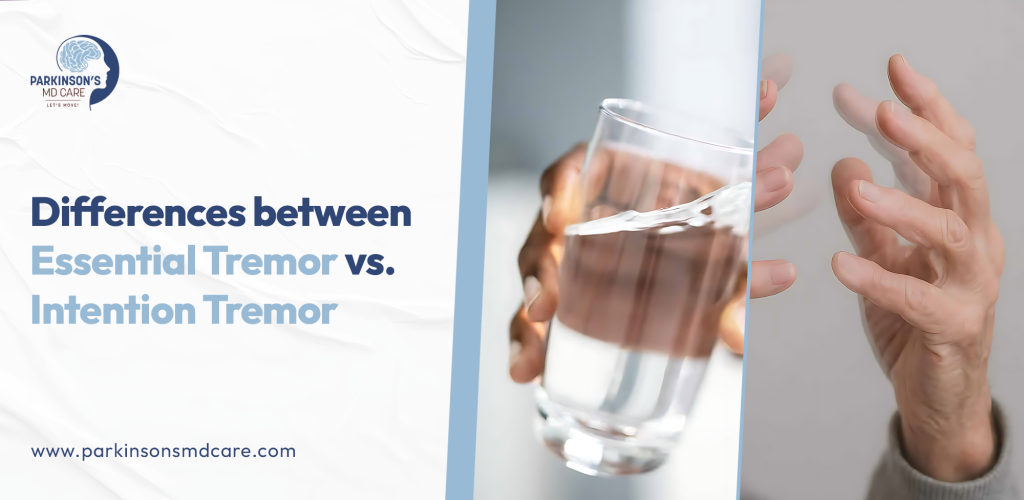
The term intention tremor, with another name cerebellar tremor, describes the condition of tremor that develops when a person performs an intentional movement toward a certain point. In contrast to essential tremor, intention tremor is pronounced as the affected limb approaches its target. For instance, while trying to grab an object like a glass, the movement starts smoothly, but as it reaches the target, it gets more shaky.
The cerebellum ( part of the brain ) controls coordination and helps to maintain balance and perform precise movements. As a rule, intention tremor indicates lesions in the cerebellum or in the pathways associated with the cerebellum. In comparison with essential tremor, intention tremor tends to be a symptom of some other neurological problem, not a disease per se.
There is much that is similar in both conditions, making it hard for a common person to distinguish between essential tremor vs intention tremor. Yet, the following guide on key differences can be helpful in this regard.
The major distinction is that of the timing of the tremor.
Essential tremor develops during movement or at times when the person is maintaining a posture, like holding a glass of water or a pen.
Intention tremor, on the other hand, develops when the person is making a purposeful movement towards an intended target and gets worse as the individual reaches the target.
Essential tremor is mainly considered to be a primary neurologic problem with a genetic predisposition. However, the etiology of this condition is not yet fully understood; there is evidence that the pathology involves abnormal connections in cerebellar networks.
Intention tremor occurs due to structural problems in the cerebellum and is caused by:
Essential tremor is characterized by rhythmic shaking which occurs when performing certain activities like eating, writing, or holding things.
Intention tremor is characterized by increased inaccuracy and shaking of movements of the arm or the hand as it attempts to reach its goal.
Symptoms are of immense significance when you want to differentiate between the two types of tremors. The following description can clear many doubts regarding the identification of conditions.
| Essential Tremor | Intention Tremor |
|---|---|
| Shaking of both hands | Tremor that worsens near the end of purposeful movement |
| Tremor during writing or eating | Difficulty reaching objects accurately |
| Head nodding | Problems touching a target |
| Voice trembling | Poor hand-eye coordination |
| Gradual progression over time | Balance impairment |
| Temporary improvement after small amounts of alcohol in some individuals | Clumsiness |
It is impossible to have an effective treatment unless it is diagnosed appropriately. Thus, in case of tremors, the significance of diagnosis is important as well as somewhat variant.
| Essential Tremor | Intention Tremor |
|---|---|
| Family history | Neurological examination |
| Tremor pattern | Finger-to-nose testing |
| Duration of symptoms | Heel-to-shin testing |
| Body regions affected | MRI of the brain |
| Response to alcohol | CT scan when appropriate |
| Absence of other neurological abnormalities | Blood tests to investigate metabolic causes |
Despite numerous similarities the both conditions may affect different body parts. Thus, this characteristic can be helpful in distinguishing the two tremors.
| Essential Tremor | Intention Tremor |
|---|---|
| Hands & Arms | Arms |
| Head | Hands |
| Voice & Jaw | Legs during targeted movements |
After an accurate diagnosis, the next important task is planning the course of action for dealing with the condition. The treatment choices come with great variation from person to person because of individualized health status, age, and severity of symptoms. Some general options are as following.
| Essential Tremor | Intention tremor |
|---|---|
| Beta-blockers such as propranolol | Stroke rehabilitation |
| Anti-seizure medications | Multiple sclerosis therapy |
| Topiramate | Surgery Surgery |
| Gabapentin in selected cases | Physical rehabilitation Physical rehabilitation |
| Botulinum toxin injections for head or voice tremor | Management of cerebellar degeneration |
Essential tremors usually occur gradually over many years. They do not shorten life expectancy, but their severity may increase and interfere with carrying out various activities. Instead, many people lead an active life after the appropriate treatment.
The prognosis for intention tremor depends on the underlying condition that causes the tremors. Those triggered by reversible conditions like inflammation can be improved with proper treatment. However, those associated with irreversible cerebellum damage are likely to last long. Yet, in both cases, early detection and proper management are essential for improvement.
In the end, any kind of tremor can turn your whole life upside down. Yet, knowing what you are actually going through can be helpful in minimizing the impact of the condition. In this context, differentiating essential tremor vs. intention tremor is critical. Both share involuntary trembling of body parts as one of their characteristics.
However, the difference between them is significant in terms of causation, timing, and symptoms. Understanding these differences helps with accurate diagnosis, identifying potential neurological problems, and choosing the right treatment. For patients exploring advanced treatment options, a guide to dbs surgery can also provide useful insight into how deep brain stimulation may be considered for certain movement disorders.
Specialists like Dr. Jawad Ahmad Bajwa from Parkinson’s MD Care provides advanced, evidence-based treatment while ensuring patients fully understand their condition and available treatment options.
Through patient education, personalized care, and ongoing support, he helps individuals feel informed and confident throughout their treatment journey. Regardless of the severity of the symptoms, an accurate diagnosis and timely, appropriate management can significantly improve treatment outcomes and quality of life.
WhatsApp us